Indoor Air Quality Solutions for West Chester Homes
Serving West Chester, Exton, Downingtown, Malvern,Phoenixville & all of Chester County



Book Your Air Quality Visit
Tell us what’s going on. A real person follows up, usually the same business day.
Indoor Air Quality, Handled Whole-Home
Air you can feel good about breathing
Dust that comes back a day after you clean, allergies that flare indoors, a musty smell the candles never quite beat: that is your air telling you something. Precision Air treats indoor air quality as part of the whole system, from the ductwork that moves your air to the filtration that cleans it and the humidity control that keeps it comfortable.
We start with what is actually in your air and your ducts, explain what we find in plain English, and only recommend equipment that solves your specific problem. Since 1993, the same honest approach we bring to heating and cooling.
Indoor Air Quality Services We Offer in West Chester, PA
Every Way to Clean Up the Air You Breathe
From the ducts behind your walls to the filter in your return, one local crew covers the whole air path. Here is everything we do.
Duct Cleaning
We clear years of dust, dander, and construction debris out of the ductwork your air travels through, so the air reaching your rooms is the air your system actually conditioned. We inspect first and only clean when there is something worth removing.
Ductwork Design & Installation
We design, seal, and install ductwork that is properly sized for your home, so every room finally gets the air it was promised. Our crew fixes the leaks and bad runs behind the walls that leave some rooms stuffy and others freezing cold.
Home Air Filters
We fit your system with 4-inch MERV-13 media filters that trap the pollen and dust a thin builder-grade filter waves straight through. Our crew sets up the right filter for your equipment so airflow stays strong and the air gets noticeably cleaner.
Air Cleaning Systems
We install whole-home air cleaning systems that treat every room your HVAC reaches, not just the one with a plug-in unit. Our crew matches the right purification to what is actually in your air and wires it into the system you already own.
Humidifiers
We install and service whole-home Aprilaire humidifiers that end the static shocks, dry skin, and cracking trim of a Chester County winter. Our crew ties it into your heating so the right humidity holds automatically, room to room, all season.
Dehumidifiers
We install whole-home dehumidifiers that pull the sticky out of Chester County summers and shut down the damp conditions mold loves. Our crew sizes it to your home and integrates it with your system so the balance holds without you chasing it.
UV Light Installation
We install UV lamps at your indoor coil to help control the bacteria and mold growth that thrive on the cool, damp surfaces inside your system. Our crew places them where they actually work and tells you honestly whether your system will benefit.
Not sure what your air needs?
Tell us the symptoms, whether it is dust, odors, allergies, or humidity, and we will track down the real cause, explain it in plain English, and only recommend what actually helps. No pressure and no upsell, just an honest read on your home’s air.
Signs Your Home’s Air Needs Attention
Your House Will Tell You When the Air Is Off
Poor indoor air rarely shows up all at once. It creeps in as smells, dust, and symptoms that everyone learns to live with. Here is what to stop ignoring.
Stubborn, musty odors
A smell that survives every cleaning usually lives in the ductwork or in humidity the house cannot shed. Freshening the air starts with finding the source, not covering it.
Dust piling up fast
Wiping the same shelf every other day means dust is circulating through the system, a sign the filtration or the ducts need attention.
Allergies flaring indoors
When symptoms are worse inside than out, pollen and dander are being recirculated instead of captured. Better filtration usually changes that quickly.
Constant coughing and sneezing
Airborne irritants that never get filtered out will keep everyone’s throat scratchy all season. Whole-home air cleaning works on every room at once.
Frequent headaches and fatigue
Stale, poorly ventilated air can leave a home feeling stuffy and its people feeling drained. Ventilation and filtration upgrades bring fresh air back into the mix.
Too much moisture, or mold
Condensation on windows, damp corners, or visible mold mean humidity is out of control, and that is a dehumidifier problem before it becomes a remediation problem.
Most air quality problems around Chester County trace back to a few fixable causes: dirty ducts, weak filtration, or humidity nobody is managing. We find which one is yours, explain it plainly, and let you decide what to do about it.
Request your free estimate
Tell us what’s going on. A real person follows up, usually the same business day.
* indicates required fields
Book an Air Quality Visit · One Call From Cleaner Air
Talk to a local team that actually picks up
Air quality problems are easy to put off because the house still heats and cools. Call Precision Air and you reach real people who know Chester County homes, take the symptoms seriously, and will tell you straight what is going on, with a visit booked fast.
- Real people, fast callbacksSomeone here picks up during business hours and gets a technician moving. After hours, an answering service has your back and you get a callback in minutes, not a recording.
- Clear answers before any workYour technician finds the cause, shows you the proof, and prices the fix in writing before touching a thing. For a new system, a project manager measures your home and lays out options at a few budgets.

“When you call, you get a person who actually helps.”
Eric Light · Owner & President
Air Quality Specialists for Chester County
Whatever you call it, we handle it.
Air purification, duct cleaning, humidity control: different words, same phone number since 1993.
Duct cleaning and ductwork pros near West Chester
Whether the search is duct cleaning near me or ductwork repair, the answer is the same local crew. We clean, seal, repair, and design residential ductwork across Chester County, so the air reaching your rooms is the air your system actually conditioned.
Whole-home air purification, not gadgets
Plug-in purifiers treat one room. A whole-home air cleaning system, MERV-13 media filtration, and UV lights at the coil treat every cubic foot your HVAC moves. We size the solution to the actual problem in your air.
Humidity control for PA summers and winters
Chester County swings from sticky July humidity to bone-dry January air. Whole-home Aprilaire humidifiers and dehumidifiers hold the balance year-round, protecting both your comfort and your woodwork.
Why Choose Precision Air
Why West Chester Homeowners Choose Us for Cleaner Air
Air quality is the easiest corner of HVAC to oversell. We are local, independent, and paid to solve problems, not to move boxes of equipment.
We look at the ducts, the filtration, and the humidity numbers before recommending anything. If a $60 filter upgrade solves it, that is what we will tell you, and the fancy purifier stays on the shelf.
Filters, ducts, purifiers, and humidity control all interact with your heating and cooling. Because we service the whole system, the air quality fix never fights the comfort equipment it is attached to.
Cleaner Air in 4 Simple Steps
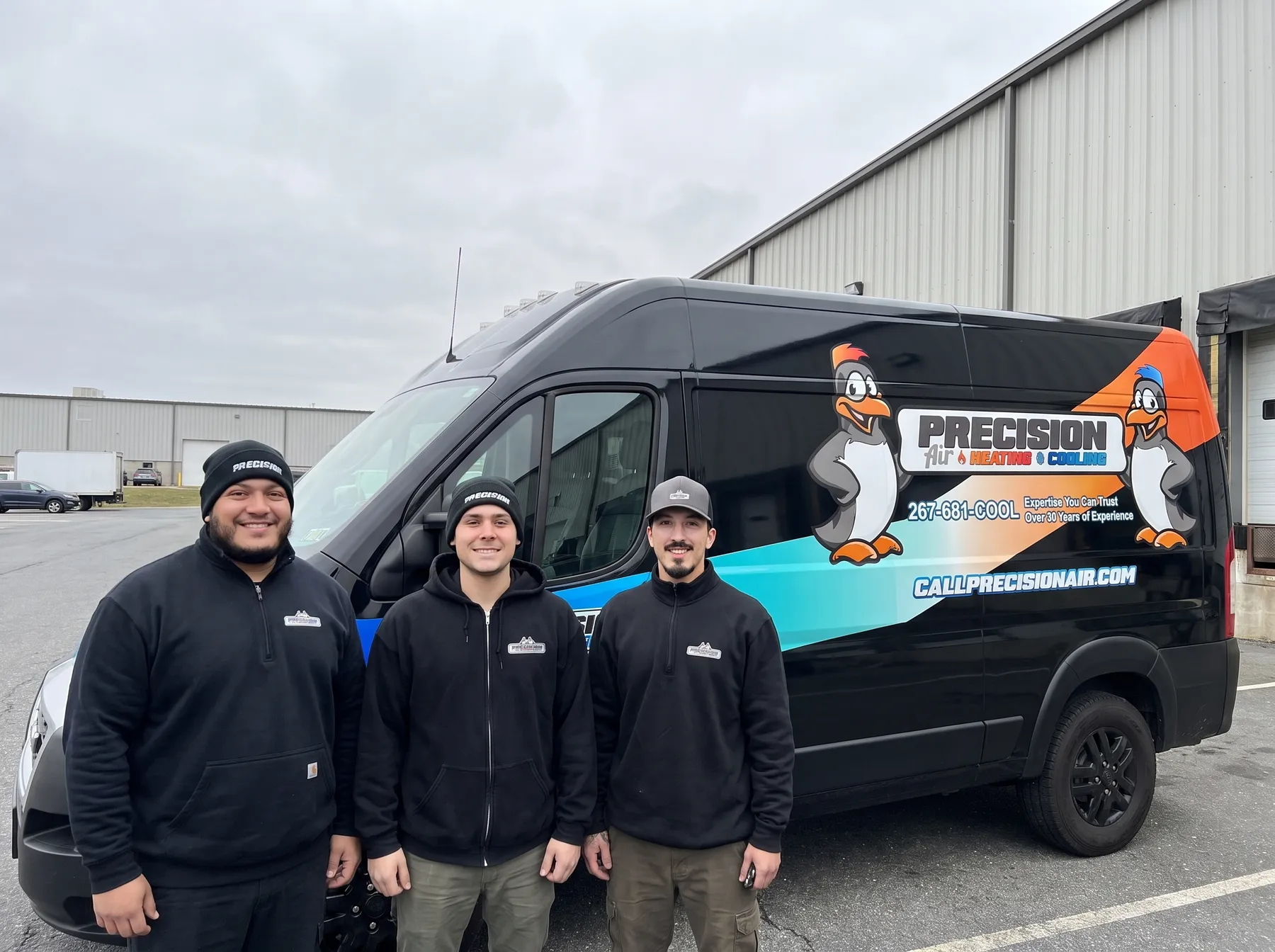
Local People Who Show Up and Get It Done
Here is what working with a local, independent crew actually looks like, start to finish.
You call, and someone here picks up.
No phone maze. Press 1 and the whole team rings at once. We get the gist, then book you in quickly, and faster when you’ve got no heat or cooling at all.
We diagnose and show you.
Your technician finds the root cause, then shows you the gauge reading, the leaking coil, or the worn part in your hands. You never just take our word for it.
You approve the price.
You get a flat-rate estimate in writing, with your options laid out plainly. Nothing is left open-ended. Work starts only when you say go.
We fix it, and stand behind it.
Most repairs finish the same visit, most installs in a day. We haul away the old equipment and every last screw. If we touched it, it’s ours to make right.
Rated 4.9 Stars by 850+ Homeowners Across Southeastern PA
Why homes like yours stick with us.
Real, verified Google reviews from neighbors across Chester County.
I’ve been using Precision for over 5 years. Every technician is polite and explains everything in a way I understand. They schedule me immediately and treat me like family.
We had a great experience. Anthony was very knowledgeable and professional. Anthony was able to quickly diagnose our issues and make the necessary repairs. We signed up for annual maintenance with Precision Air moving forward.
Donnie, Peter, Jake, and the entire install crew were fantastic. The mini-split install looks amazing, clean and neat, and they were professional and respectful of our home.
 D
DWe got a new HVAC and cooling system from Precision Air this past summer. From our first meet with them for our consultation, to installation and then even with a small glitch after install, every team member was professional, friendly, always responsive in a timely manner.
My sixth visit from Precision over the last few years, and every experience has been fabulous. They beat all the other quotes I received and gave me superior equipment.
Indoor Air Quality Service Across Chester, Delaware & Montgomery Counties
Chances are, we already know your street.
Precision Air is based in West Chester and covers all of Chester County, plus neighboring Delaware and Montgomery counties, with the same air quality crew in every town. Not sure you’re in range? Give us a call and we’ll confirm in about a minute.
Don’t see your town on the list? Give us a call. Chances are our penguins patrol it too.

Indoor Air Quality FAQs
Your air quality questions, answered straight.
Answer-first replies to what Chester County homeowners ask us most about the air in their homes.
Still have a question? Call usHow do I know if my home has an air quality problem?
What indoor air quality solutions do you install?
Will a better filter really help my allergies?
Do I need my ducts cleaned?
My house is too dry in winter and sticky in summer. What fixes that?
Do UV lights actually work?


Ready When You Are
Cleaner Air, Done the Right Way.
Tell us what you are noticing in your home’s air and we’ll give you a clear, honest read on the cause, and a fix priced upfront. One local crew for the whole system.
Family-owned in West Chester since 1993 · ★ 4.9 from 850+ Google reviews